 Jhuli
Jhuli
Ekalavya and the Clay Teacher
Mahabharata · Ages 9-12 · 5 min read
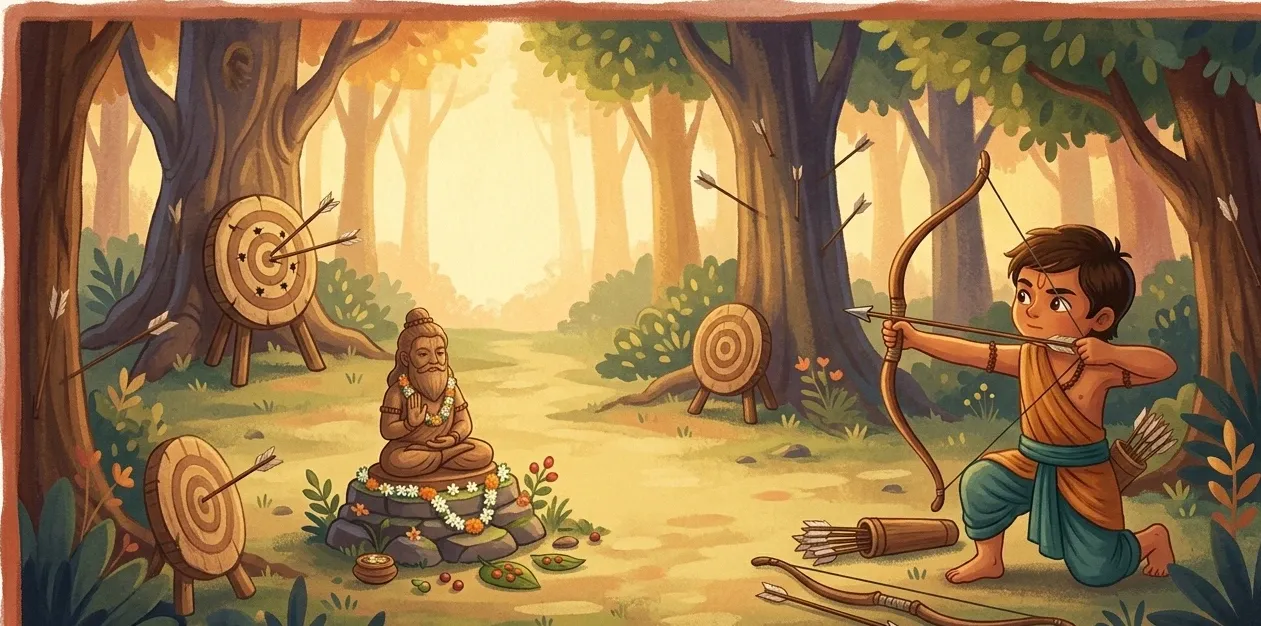
In the forests at the edge of a great kingdom there lived a boy named Ekalavya. He was the son of a hunter, and he wanted, with his whole heart, just one thing in all the world. He wanted to be the finest archer in the land.
Now, the greatest teacher of archery anywhere was a master named Drona, who trained the young princes of the kingdom. So Ekalavya walked out of his forest, found the master, bowed low, and begged to be taken as a student.
But Drona said no. He taught princes, not the children of forest hunters, and he sent the boy away.
Most boys would have given up. Ekalavya did not. He walked back into the forest, and with his own hands he shaped a statue of Drona out of river clay. He set it up in a quiet clearing, and he bowed to it every single day, exactly as he would have bowed to the living master. “You are my teacher,” he told the clay figure, “whether you will have me or not.”
And then, alone, he practised. Day after day, season after season, he watched the birds and the wind, and he fired arrow after arrow after arrow before his clay teacher, teaching himself through nothing but devotion and effort, until at last he could shoot better than almost anyone alive.
One day Drona himself passed through that part of the forest with his royal students. And they stopped, astonished, for here was a forest boy whose archery was finer than any of theirs, finer perhaps than the very best prince among them.
“Who taught you such skill?” asked Drona.
Ekalavya’s face shone with pride. He led the master to his clearing, to the little clay statue. “You did,” he said simply. “I made you my teacher, and I have practised before you every day.”
Now, this should have been a moment of pure joy. But it was not so simple. Drona had promised that one particular prince of his would be the greatest archer in all the land, and here stood a self-taught forest boy who was greater. And so the master did a hard and troubling thing. By the custom of those days, a student owed his teacher whatever gift the teacher asked. And Drona asked Ekalavya for the thumb of his right hand, knowing that without it the boy could never again draw a bow as he had.
Ekalavya did not argue, and he did not weep. To him, the bond between a student and a teacher was a sacred thing, and his devotion to it ran deeper even than his own dream. Without a moment’s hesitation, he gave what was asked.
Some who hear this story feel only the wonder of such pure devotion, that a boy would so honour a teacher who had never once taught him. Others feel the sorrow in it, that so much was asked of someone who had only ever wanted to learn. Perhaps it is right to feel both at once.
An original retelling of the story of Ekalavya from the Mahabharata (public domain).