 Jhuli
Jhuli
Shabari's Berries
Ramayana · Ages 5-9 · 4 min read
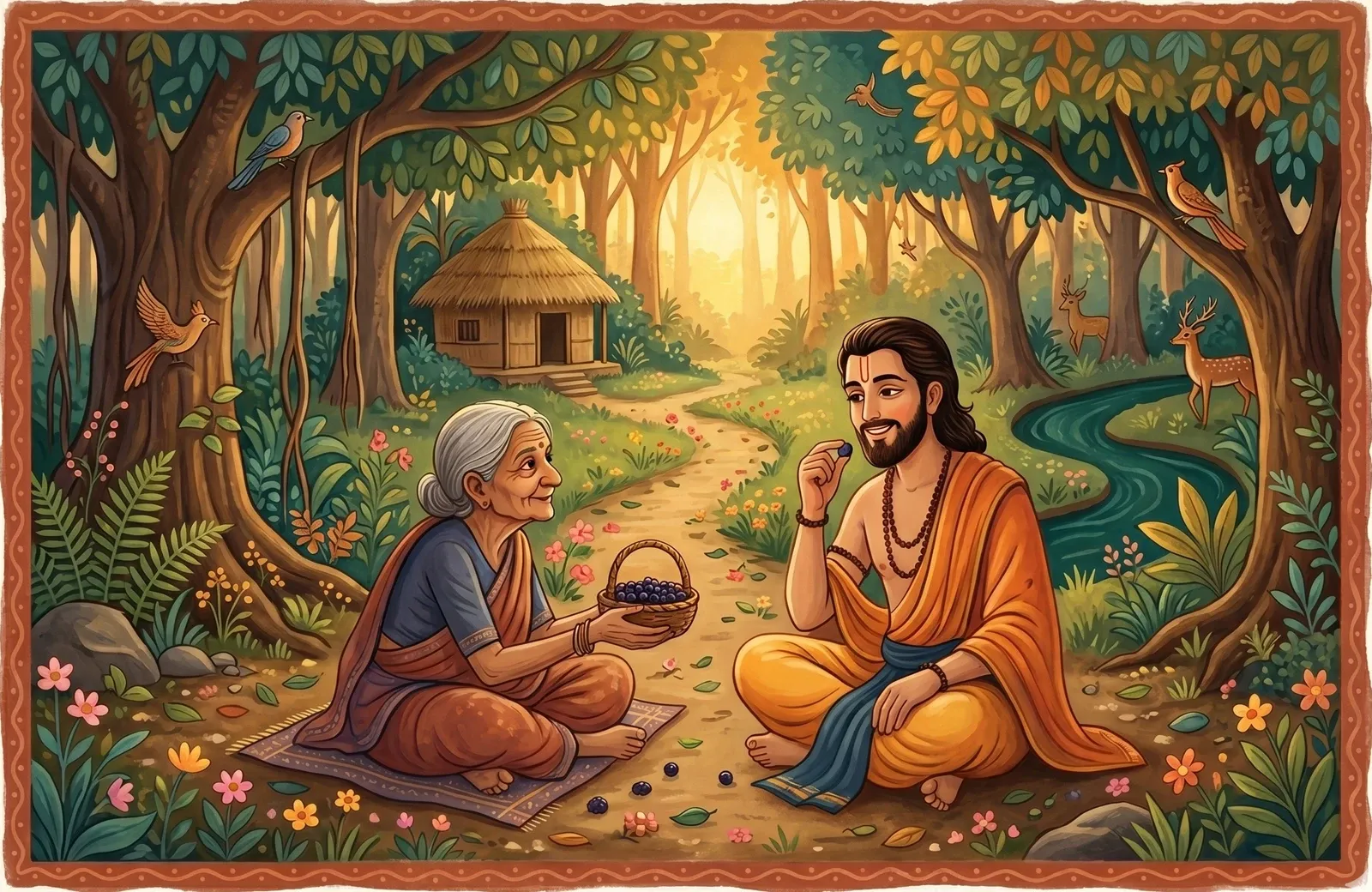
Deep in the forest, in a small clean hut beside a stream, there lived a very old woman named Shabari. She was poor, and she had no family, and her hands were wrinkled as old leaves. But her heart was patient in a way that is hard to explain.
Many years before, a wise teacher had told her something. “One day,” he had said, “Rama will pass this way. Wait for him, and serve him well.” And Shabari had believed it. She had believed it for so long that her hair had turned white with the waiting.
Every single morning she rose before the sun. She swept the path through the trees so it would be soft under his feet. She laid fresh flowers along it. And then she went out to gather ber, the small sweet wild jujube that grew on the forest bushes, so that there would be something good to give him when he came.
But Shabari worried. Her eyes were old. What if a berry was sour? What if she gave Rama one that made him wince? So she did a careful thing. She tasted each berry first, just a small bite, and the sweet ones she kept in her little basket and the sour ones she threw away. Sweet, keep. Sour, away. Day after day, year after year.
And then, one ordinary morning, two men came walking down her swept and flower-strewn path. One of them was Rama.
Shabari could hardly breathe. She had nothing grand to offer, no feast, no gold. Only her basket of little berries, each one already bitten. Her hands shook as she held it out. “I tasted them,” she said, almost ashamed. “I only wanted to be sure they were sweet enough for you.”
Rama sat down right there on the forest floor. He took the berries from her old hands, and he ate them, every one, and he smiled the whole time he did it. “In all my life,” he said gently, “I have never been given anything sweeter. Because you put your whole heart into each one.”
And Shabari, who had waited a lifetime for this single morning, felt that all of it, every swept path and every tasted berry, had been worth it.
An original retelling of the story of Shabari from the Ramayana (public domain).